Research programme

Six work packages, one integrated path from evidence to practice.

The four-year programme combines in-situ data, experimental campaigns, numerical modelling, vulnerability assessment and retrofit concepts.

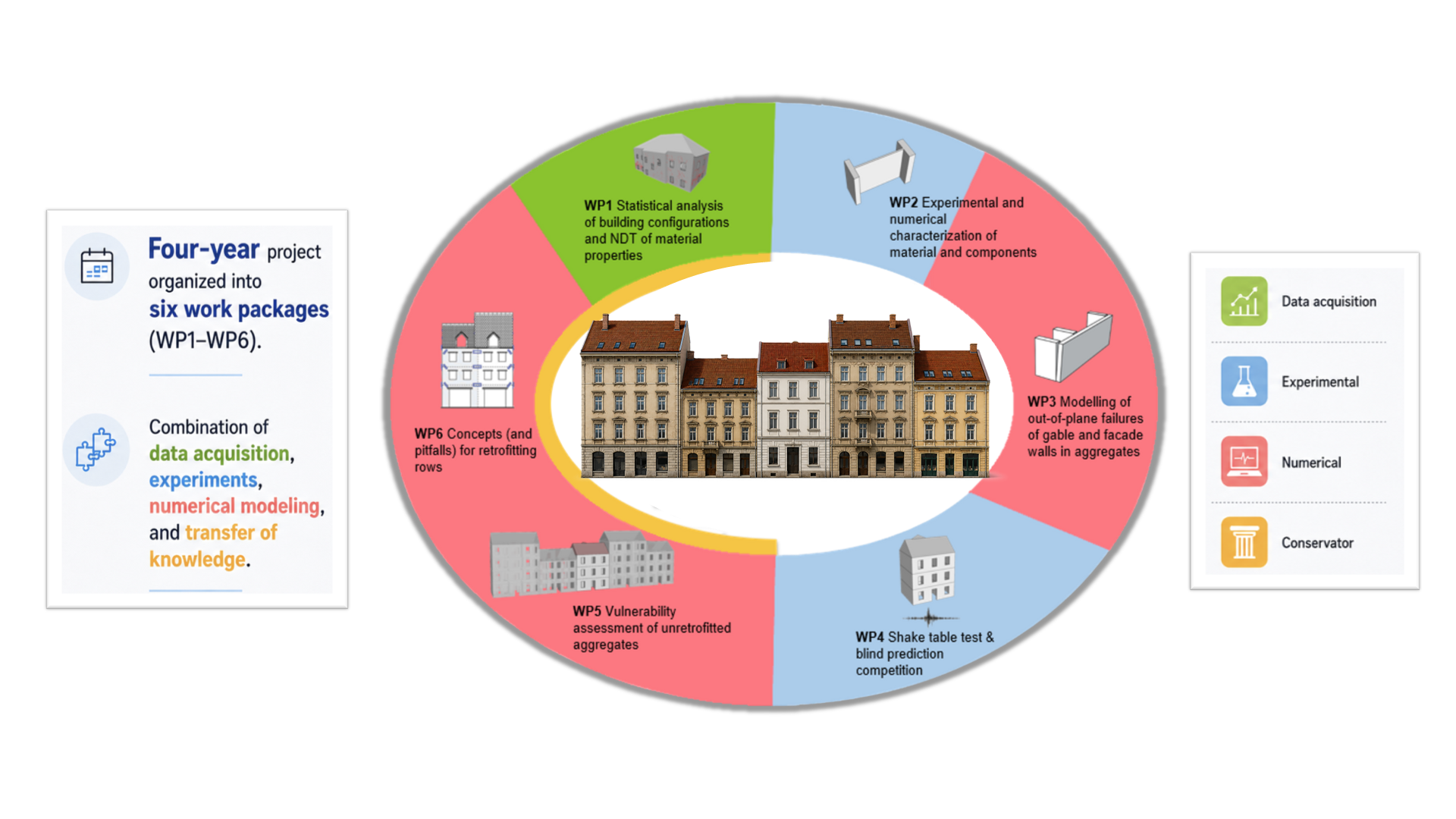
Diagram showing the six ZAGGREGATE work packages and links between data acquisition, experiments, numerical modelling and conservation
One integrated research programme. Field data, experiments, numerical modelling and conservation expertise feed into one another throughout the project.
WP1 building typologies and in-situ data
WP1

Building typologies & in-situ data

WP1 builds the evidence base for the project. Field surveys and GIS data document geometry, structural systems, construction history, position in the row and interaction with adjacent buildings.

  • Typology and exposure database
  • Damage-pattern classification
  • Ambient-vibration, sonic, flat-jack and gap measurements
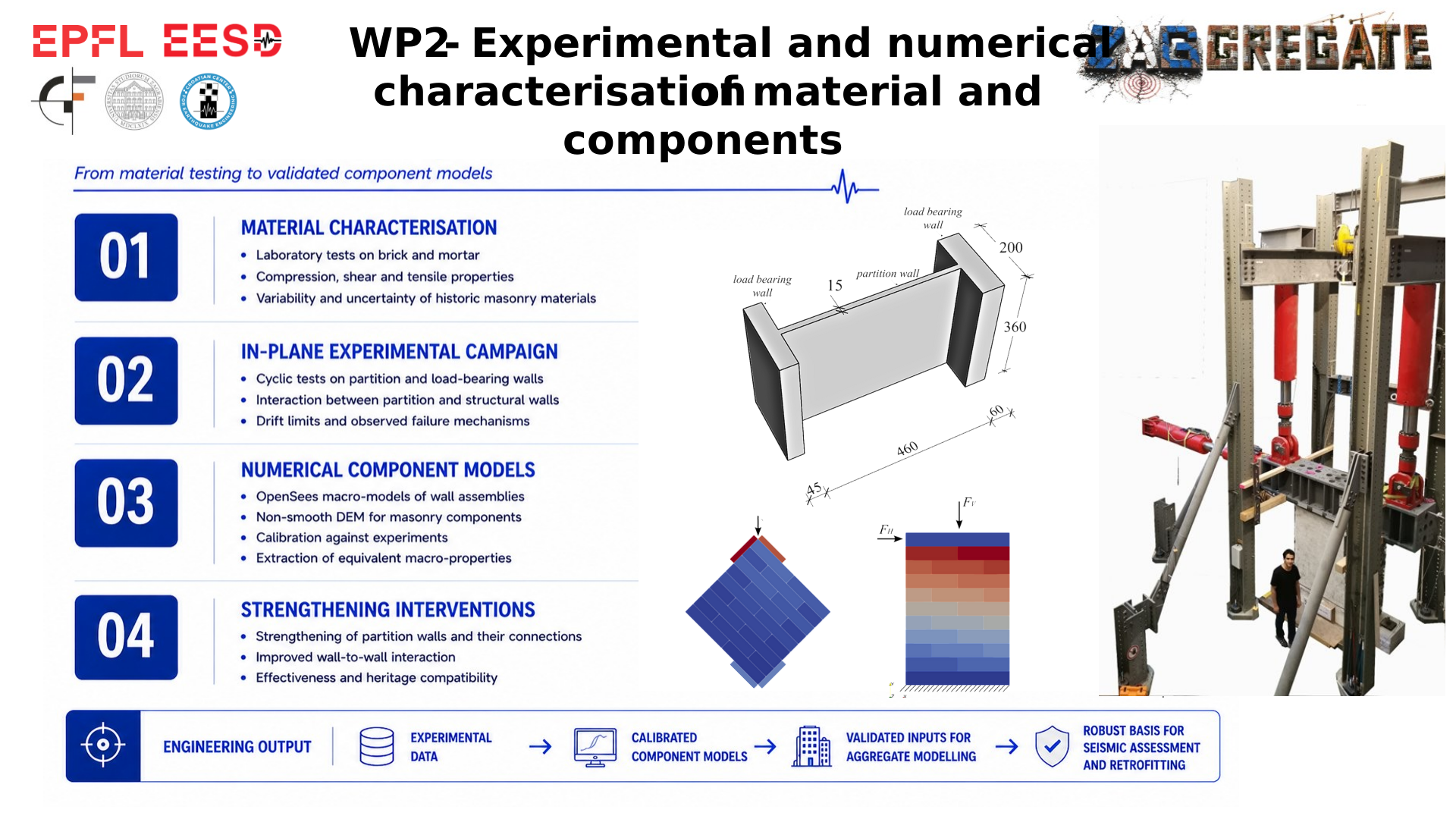
Output: calibrated inputs for aggregate-level assessment
WP2 material and component characterisation
WP2

Material & component characterisation

WP2 studies how historic brick, mortar, walls and connections behave under load. Laboratory campaigns are paired with numerical models so measured behaviour can be transferred to complete aggregates.

  • Mechanical properties and uncertainty
  • Cyclic in-plane tests on walls and partitions
  • Calibration of models and strengthening solutions
Output: validated material and component models
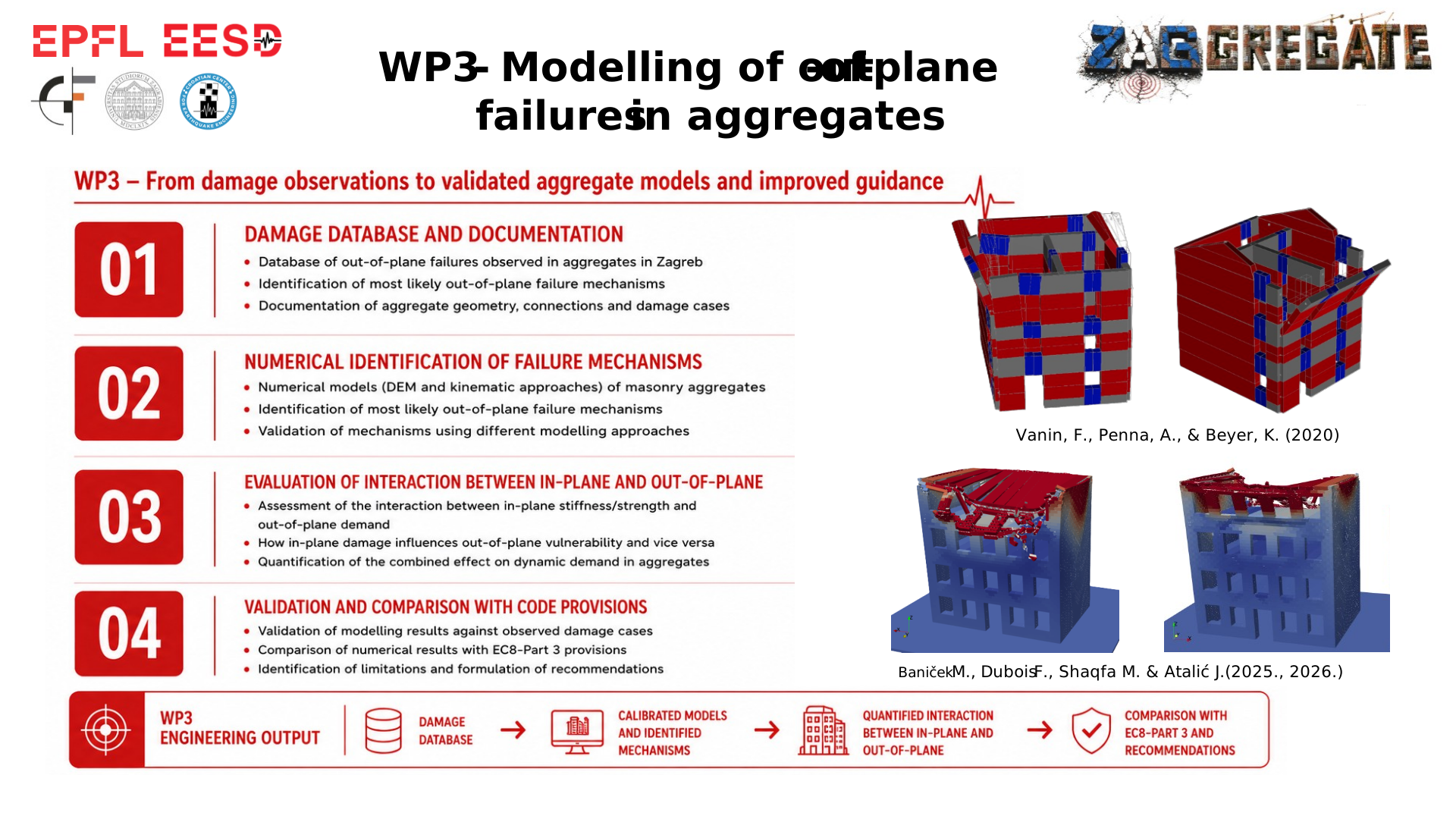
WP3 out-of-plane failure modelling
WP3

Out-of-plane failures in aggregates

WP3 investigates façade and gable-wall failures, including interaction between in-plane damage and out-of-plane instability. Observed damage identifies and validates likely failure mechanisms.

  • Database of out-of-plane failures
  • Discrete-element and kinematic modelling
  • Comparison with Eurocode 8 provisions
Output: validated mechanisms and modelling recommendations
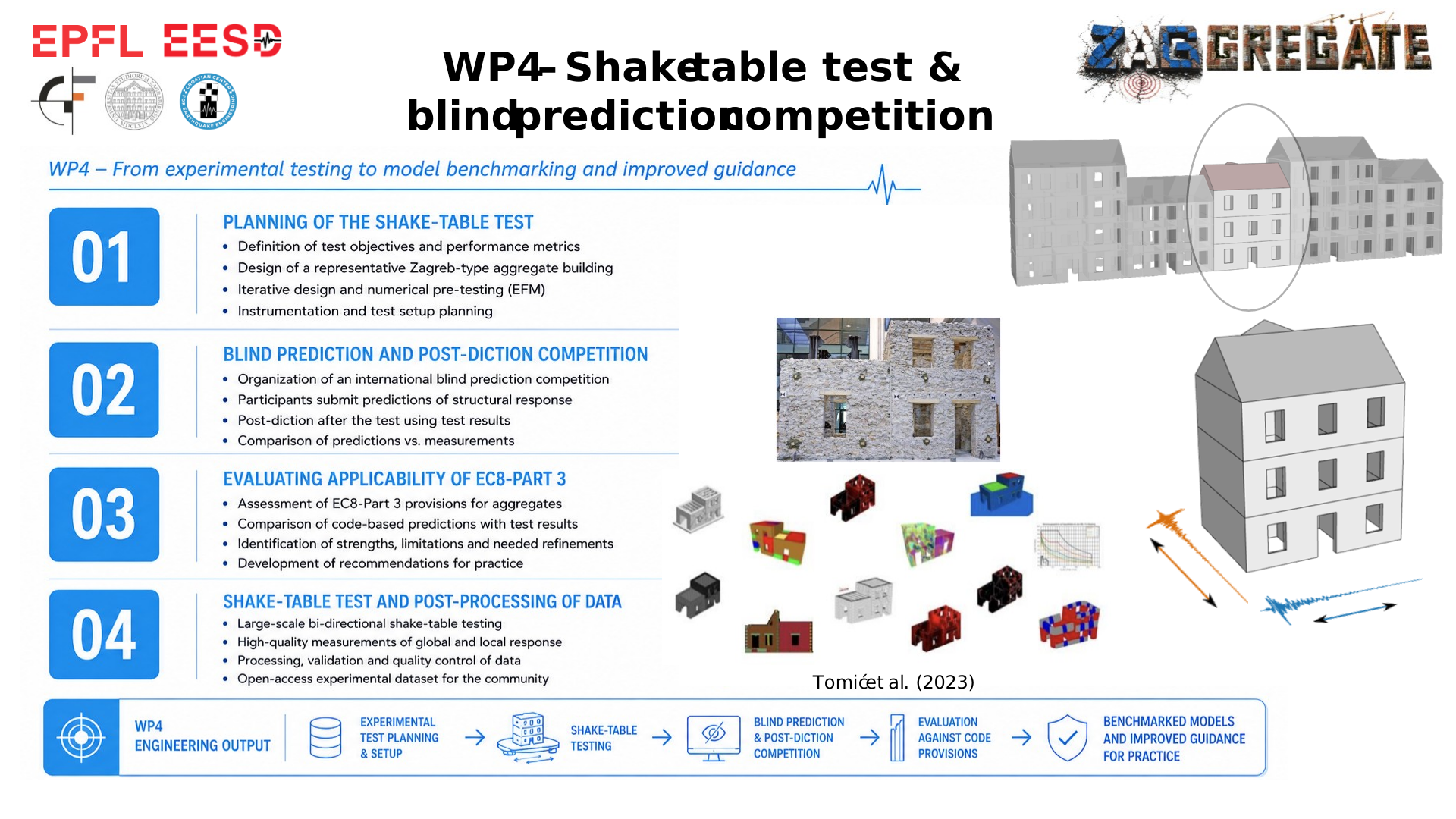
WP4 shake-table test and blind prediction
WP4

Shake-table test & blind prediction

WP4 provides the large-scale experimental benchmark. A representative Zagreb-type masonry building is tested under bidirectional earthquake excitation after international teams submit blind predictions.

  • Specimen design and numerical pre-testing
  • Blind prediction and post-diction competition
  • Open experimental data and benchmarking
Output: benchmarked models and improved guidance
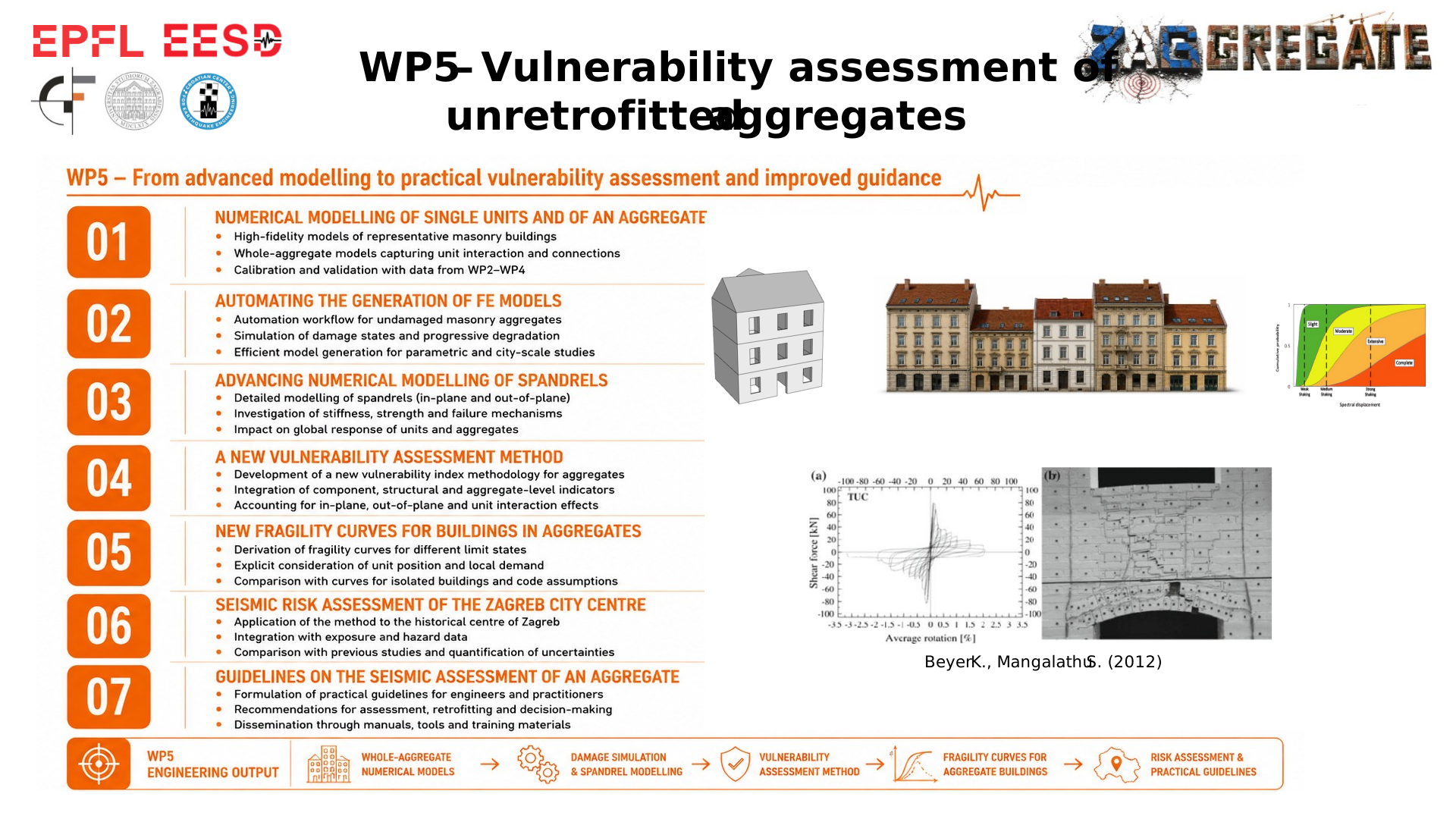
WP5 vulnerability assessment
WP5

Vulnerability of unretrofitted aggregates

WP5 moves from individual analyses to vulnerability and fragility at aggregate and city scale, examining position, neighbouring units and acceleration amplification.

  • Unit- and aggregate-level fragility curves
  • Efficient earthquake intensity measures
  • City-scale risk scenarios for Zagreb
Output: quantified vulnerability of existing aggregates
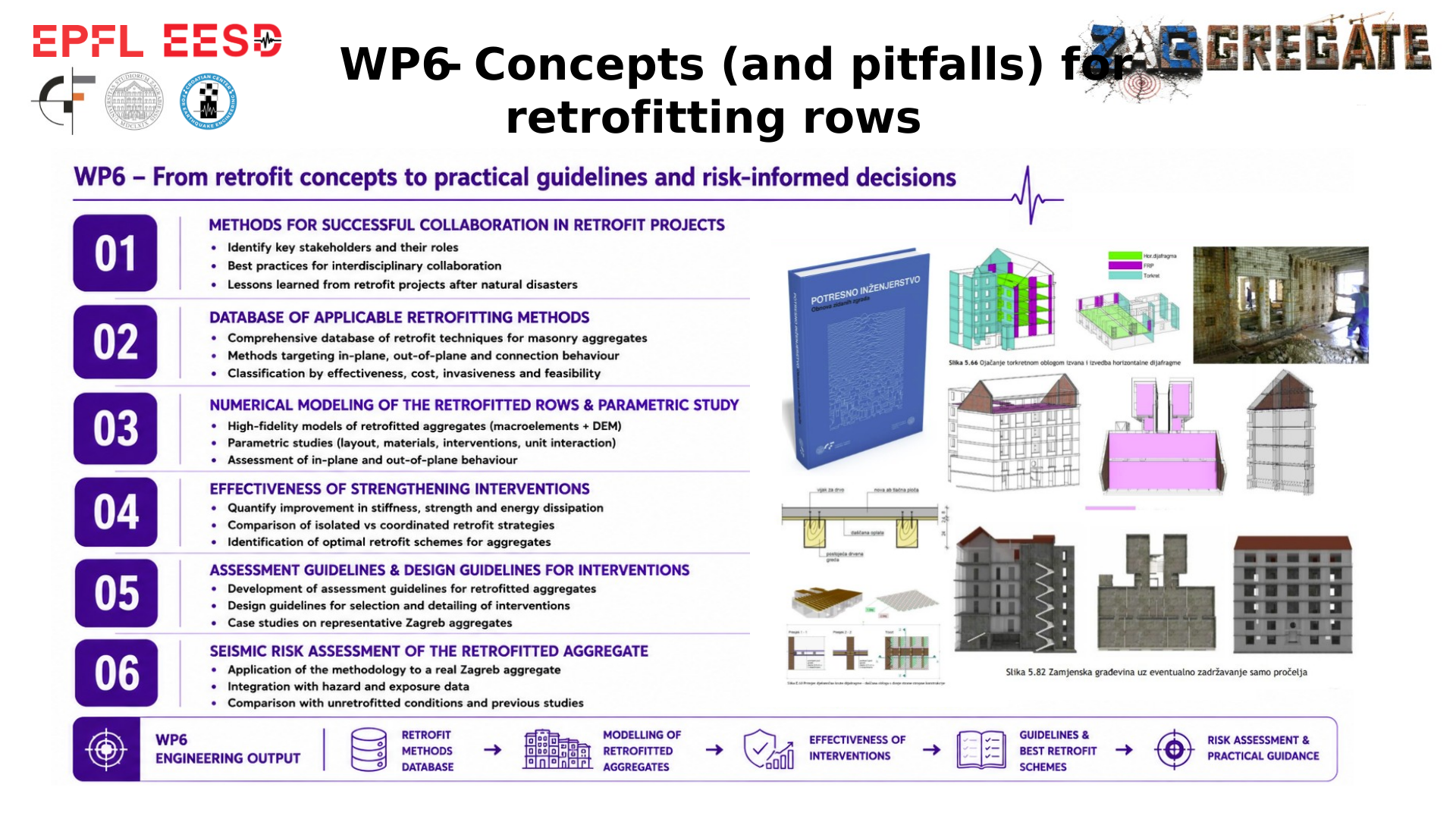
WP6 retrofit concepts and guidance
WP6

Retrofit concepts & guidance

WP6 compares isolated and coordinated interventions to improve safety without transferring risk to neighbouring buildings. Effectiveness, feasibility and compatibility with historic fabric are considered together.

  • Database of applicable retrofit techniques
  • Parametric studies of strengthened rows
  • Assessment and design guidance
Output: practical, risk-informed retrofit guidance
Four-year roadmap

From field evidence to guidance and impact.

The work packages overlap by design: measurements inform models, experiments validate them, and vulnerability studies shape retrofit concepts.

Year 1Year 2Year 3Year 4
WP1Field data & typologies
WP2Laboratory campaigns
WP3Out-of-plane modelling
WP4Shake-table test & prediction
WP5Vulnerability assessment
WP6Retrofit concepts & guidance
Meet the collaborationExplore the team & partners →